Author: zora

Buy This Book: Day of Honey

For weeks, since I read Day of Honey cover to cover in a big, delicious rush, I’ve been mulling over a lengthy proper review in my head. Great books about the Middle East are so rare that they deserve splendid treatment.

But I finally realized that’s not going to happen. I already lent my copy to someone else, and gave three more copies to friends. All the details are slipping away. But here’s the essence: Annia Ciezadlo writes about people in the Middle East like they’re real live individual human beings, not political pawns or members of the “Arab street.”

Ciezadlo was a reporter in Iraq not long after the war started, then settled in Beirut just before Israel’s war with Lebanon began in 2006. The book covers her time in both countries, with the added complication of basically being on her honeymoon with her Lebanese husband (also a reporter) when she first heads to Baghdad.

Even with all the chaos around her, Ciezadlo focuses on the still points, the regular daily rituals people go through even when–especially when–everything else is going to shit. This naturally leads to food–the seemingly simple grilled fish Iraqis treasure, the beautiful preserves the Lebanese live on in wartime, and, where the book gets more personal, what Ciezadlo’s mother-in-law teaches her to cook in Beirut.

Day of Honey is also one of the best-written books–on any topic–that I’ve read in years. There’s so much wit here, and sharp observation, and hilarious turns of phrase (why yes, those freelance mourners who crash funerals and chant the Quran–they are “a kind of squeegee men of mourning”). I’d quote more, but, as I said, my book is lent out. Instead, read this review in the New York Times, which is densely packed with some of the finest lines (though certainly not all).

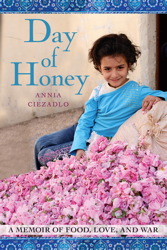
A note about the cover: Don’t judge by it. One of these years, American book publishers will understand that not every book about the Middle East needs to be covered with children and flowers to make it less scary.

And here’s another link to buy the book, just for good measure. And please tell your friends.

Moon New Mexico Giveaway

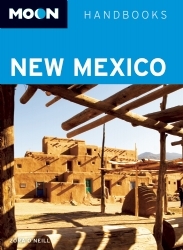
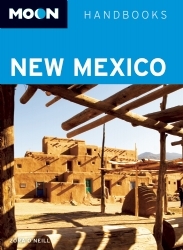
Whoo-hoo! Free stuff! I just got a big ol’ box of copies of my new Moon New Mexico guidebook, hot off the presses.

And you reap the benefits: I’m giving away four copies, so you can get your summer travel planning started right. To enter, just leave a comment below by Monday, April 4 at midnight (end of the day Monday). I’ll pick four random numbers that day.

I’m not judging the quality of your comments, but it would be fun for everyone if you told us where your favorite place in New Mexico is, where you’d most like to go or how old you were when you finally realized New Mexico is part of the United States.

Let the games begin…

Queens Writers Fellowship, Round 2

It’s just about time to say goodbye to Heather Hughes, who was a great fellow-writer here for the last couple of months. So, the Queens Writers Fellowship continues.

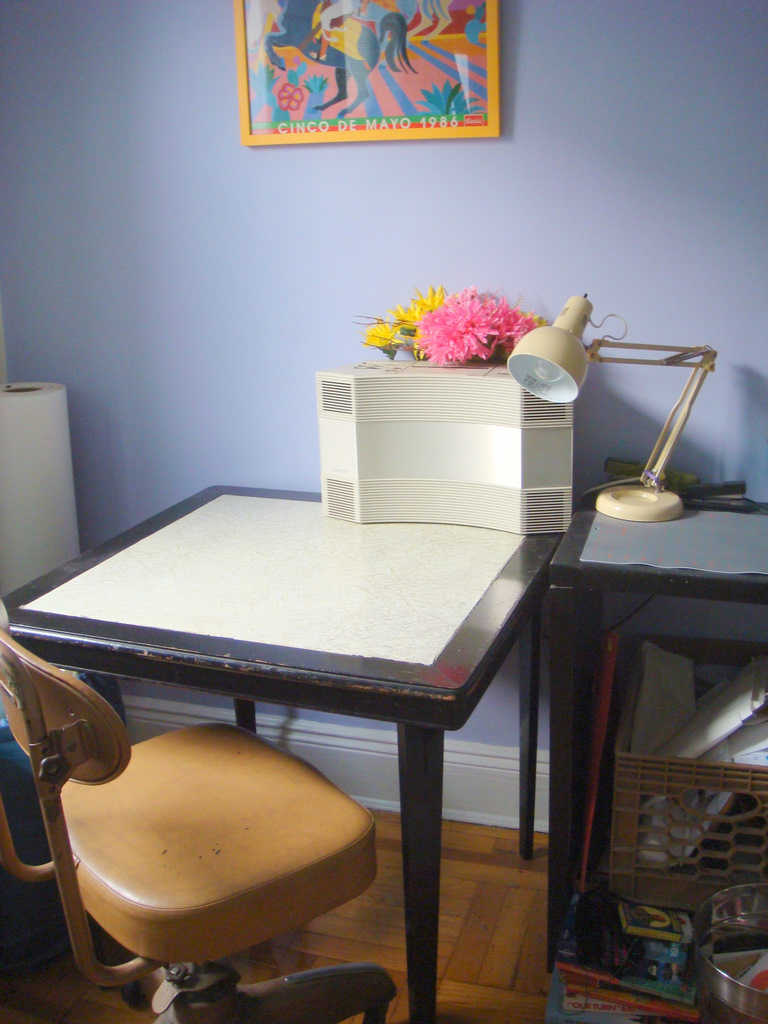
Who’s up next? This desk could be yours. This next round will be a little short, due to my travel schedule: early April through near the end of May. There’s a week or so around Easter when I’ll be gone. And there are a few days (yet to be scheduled), when I’ll be working out of the house.

I’d love to hear from flexible people who want to come over and work in my office during that time. Using Heather as our QWF test case, I’ve found that five days a week usually isn’t totally feasible. But I felt like it was a good week when we worked together three days out of five. And if we can manage more, that’s great.

So, if you’re interested, drop me a note before April 1, and let me know what you’re working on, where you live, how much you aspire to come over and write–that kind of thing. I’d like to get the next fellow started in here by April 11. If you applied last time, just drop me a short note to let me know if you’re in or not for this time.

And even if the next time slot doesn’t work so well, let me know–I’m always curious to hear from more writers and workers-from-home in Queens. I’d like to get this next

New Goodies

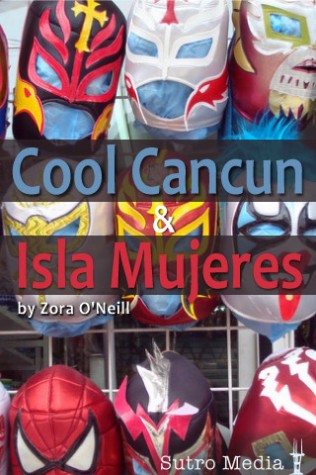
Just wanted to let everyone now that a new version of my iPhone app, Cool Cancun & Isla Mujeres is out. And it should now really be titled Cool Cancun & Isla Mujeres & Puerto Morelos–but that’s just a little unwieldy, no? I added 20 new listings for my favorite under-the-radar beach town, which is only about 20 minutes south of Cancun Airport–so an easy day-trip, or a great destination on its own. The price is still a bargain at $1.99–spread the word to anyone who’s headed down that way for spring break or beyond.

And I just got a huge box of the brand new Moon New Mexico guide! They look great, if I do say so. They have more color photos, and overall, I think the book is just a bit tighter all around. I found some really excellent restaurants, and got out to some even farther corners of the Land of Enchantment. And, as usual, the update website is there as backup–I’ve already got one small change posted, in fact. (Such is a guidebook writer’s life…)

Watch this space for a book giveaway later this week!

Dubai Is the Future, part 2

[continued from part 1…]

We arrived at the other side of the creek just as the Friday noontime prayer started. Aside from a few tourists milling around, taking pictures of the same penis-shaped minaret as we were…

Dubai Mosqu

…the streets were deserted. We took our usual stroll through a supermarket, marveling at the mishmash of Indian, Arab and Asian products on the shelves.

All Purpose Sauce

A man steered us away from the Thai fruit juices, pointing to a can of mango juice made in Abu Dhabi and saying, “From here. Fresh!” with pride.

(Wait, was that a real Emirati?! We didn’t stop to marvel like we should have!)

One back corner of the store was fenced off with a chest freezer, blocking the entrance like a fort. Oh, hey—what’s in there?

Pork Products

Oh, I see. Wait, who are those products for?

Pork Products (Not for Muslim)

But…what if a Muslim wants to buy these things?

Non-Muslim (Pork Products)

Ah. No. Got it. Got it.

Finally, we had lunch at a pretty basic Indian joint, which we chose for the special clatter of stainless-steel plates on stainless-steel tabletops, and the intriguing-looking fish dishes. It wasn’t the most amazing food, but it contributed to our sense that the earth’s center of gravity had shifted.

We were in a world oriented around an ocean we knew only from globes, built on thousand-plus-year-old trade routes that were just dashed lines on a map we’d seen on the endpapers of a book. The United States felt like an irrelevant blip.

In the Dubai that is our future, American culture will exist only as a distant reference point—those people who invented the mall, the megaresort and the musical fountain. (And actually, I’m not even sure about the latter two.)

And in the future, apparently there are no women. Dubai is so reliant on guest workers that they make up about 80 percent of the population. Of those workers, the substantial majority are men. Women work in houses. Or, if they’re Emirati, live in houses and can only be seen in the comfortable confines of the luxury wing of the Dubai Mall.

Another unfortunate loss in the future will be subway etiquette. Despite pamphlets with cartoons urging riders to stand aside and wait for people to exit the train car, it was a vicious scrum every time the doors opened. Peter theorizes that multicultural societies have fewer superficial politenesses like this, because no one quite trusts or knows the standards.

I love me a multicultural society, but Dubai trumped New York City for boneheaded subway behavior, and that’s saying a lot.

Dubai Metro

It looks harmless, but wait till the doors open.

We avoided that unpleasantness once by splurging on a “gold” ticket on the metro, just because we could, and sitting in padded-seat luxury in the front car. There was even an attendant (a woman!) to inspect our tickets and keep out the interlopers.

In the future, as an American I probably won’t be able to afford this privilege–and that may be the most unsettling aspect of all. Maybe I can find work on a dhow…

Dubai Is the Future, part 1

When we use up all our water. When labor becomes completely globalized. When climate change sends temperatures above 120 degrees. When government regulation becomes so hated that zoning rules are chucked. Dubai is what the future will be.

When Dubai was being built up, only about a decade ago, I was totally smitten. It was thrilling to see so many creative buildings and over-the-top plans implemented in one place.

But I only got around to going to Dubai this year, on a stopover to Bangkok. After the whole project started to creep me out a little bit. After I’d read a few exposes about labor practices, and after the gloss of an indoor ski slope wore off, and it just seemed hubristic and wrong.

Dubai Sunset

The first indication that we were in an odd place was in the immigration line, when we realized that the random guys in snow-white robes and starched headdresses walking around were actually officials, as were the guys in robes at the desks. Why they got to walk around in their everyday Emirati clothes, and not in any kind of uniform, only dawned on me later.

Then we marched over to the metro. Or we tried to. We got lost and wound up in a bus bay, and I asked a driver where the metro was. First I tried asking in Arabic, and then realized how dumb that was. The guy was Indian, and told us in perfect English where to get the metro. At the metro, more people told us in perfect English how the system worked. It’s the first time I’ve been in an Arab country where my Arabic was utterly useless.

The next day, we zipped all over the place on the metro—or really, just back and forth, as it’s really only one very long, perfectly straight line. At each stop, I noticed there was always one very bored man in a white robe sloping around.

And then I finally saw a woman make a beeline up to one of these guys and ask him a question. Ohhhhh. The robe was the uniform. That’s how you, if you were a native Dubai-ite, or an Arab of any kind, could know who spoke Arabic. Poor guy had nothing to do in general, but every so often, he had to fend off a cranky person waving a metro card and complaining.

In the Mall

We went to the mall, and saw the same thing. Each info desk was staffed with four polyglot, global-looking people, and one guy in a robe. And the head-to-toe black-clad super-glam shopper-ladies, with their black hijabs piled up high over giant, towering bouffant hairdos (oh, how I love this look!) and their gold trickling down their wrists and their lavish black eyeliner—these ladies knew exactly who to ask for directions to the frozen-yogurt store.

Only once in our admittedly short visit did we ever naturally interact with a native Dubai resident. It was one of those guys on token-Arab duty in the metro, who busted Peter for not having put enough money on our cards.

And why would we have such an interaction? Full Dubai citizens are the upper-upper class, and the rest of the country is filled with guest workers who handle all the tedious stuff, like interacting with tourists. It’s the normal travel situation—in which you meet all kinds of taxi drivers, hotel clerks and tea-sellers, but never your peers—thrown into sharp relief.

Peter and I tried to buck the system. We ignored his brother’s advice not to walk around (“Yes, you don’t want to live there. Don’t fight it. Cabs are cheap.”) and set off on foot from our hotel. The weather was balmy, but podlike air-conditioned bus shelters hinted at a more terrifying climate. We walked along wide boulevards lined with faceless buildings, every window tinted or mirrored to keep out the blazing sun. (“Here’s a cliché for the guidebooks,” Peter snickered. “‘In Dubai, even the buildings are veiled.'”)

Dhow Loaded Up

We wound up at the docks, lined with dhows. I had just read a lot about them in Tim Mackintosh-Smith’s book Yemen: The Unknown Arabia, and was delighted to see these grand wooden ships in person, looking like they’d just sailed in from the fourteenth century, fresh from a trading jaunt across the Indian Ocean. Now they were getting loaded up with tires, bags of rice and innumerable boxes stamped “Made in China.”

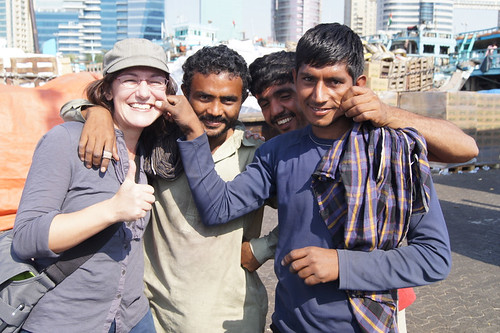
No one spoke Arabic here, either. These men were from Bangladesh. We were the most interesting thing they’d seen all day.
Dhow Boys

So were my breasts, apparently. Cheek-squeezing devolved into a clumsy boob-grab. (If only boob-grabbers knew what they were doing! But by definition, a boob-grabber has no experience with boobs. Getting fondled on the street used to make me feel preyed upon and victimized; now it just makes me feel sorry for the dudes.)

We hopped a boat across the “creek,” the little river that flows through the oldest part of Dubai. We meant to take an old-fashioned one, where you’re hanging inches above the water and holding yourself up as if you’re a straphanger on the subway. But instead we wound up on a proper posh city-run boat.

Stay in Your Seat

(to be continued…)

5 Essential Travel Strategies

Recently, a friend suggested I write a book about how I travel. But I doubt I’m the only person who thinks this way, and it doesn’t really merit 200 pages of musing. And I’m happy to give away my so-called wisdom for free. These are the things I tend to do on the road. How about you?

Rule #1: Accept any FOOD you’re given.
Food is the easiest, most concrete way to make a connection with someone with whom you might not share anything but this moment when you’re both munching on pig-blood-soaked coconut and smiling at each other. It doesn’t matter whether you don’t speak the same language, or live under different political systems or whatever.

Ag Museum: Dinner!

Besides, refusing food is just rude. Somebody is being hospitable in the most fundamental way they know–offering you something that will keep you alive.

Vegetarian? You can be veg when you order your own food. But when someone shares his plate with you at a restaurant, or gives you a free kabob just because you smile sweetly and say thank you in the local language–just take it. You’ll live.

So you might get sick. Big deal. You’ll get over it–and you’ll even have another good story to tell. (Celiac–fine, you get a pass.) Just smile, say thanks and eat the thing. You might even like it. (I liked that pig-blood stuff! Who knew?)

Read more

#Egypt #Egypt #Egypt!

Garden City GateI’m always surprised when I see a picture of Cairo and it isn’t sepia-toned. Not from some nostalgic glow, but from the dirt. The city, in my memory, is an even dull beige. That’s because it’s freshly coated every spring with a layer of dust from the khamsin wind, and never fully scrubbed clean.

Sand and dirt and trash has been piling up in Cairo for millennia–it’s not exactly a clean city. But the last time I visited, in 2007, it felt like Cairenes cared even less than usual–like the city had nearly crushed its own inhabitants. So, in the midst of the protests of the last two weeks, I was most touched by the images of the protesters collecting trash, organizing recycling and scrubbing the streets. Could the layers of grime in the city really just have been symptomatic of a generation-long bout of depression? The gloom has finally lifted. Boy-boy (Bye-bye), Mubarak–first phase of house-cleaning complete.
Read more