Author: zora

The day before

Like I said, it wasn’t so thrilling. In fact, I wrote about it last night, then I lost interest, so I saved the post…or so I thought.

The only two moments I want to recreate are:

1) The super-intense (and very knowledgeable) woman at the tourist office in Las Vegas telling me that she’s a big supporter of the Jews, because, well, without the Jews, there wouldn’t be any Bible. Then she told us some anecdote involving a child saying something cheeky-but-oh-so-true about Jesus. This came up because we’d asked the whereabouts of a Jewish cemetery someone had mentioned to us earlier.

2) We stopped at a U-pick raspberry farm, and got some raspberries. They were good and all, but that’s not the point. More fascinating: I believe this is the first time I’ve ever been doing guidebook research and gotten somewhere during the correct season. I am forever peering in windows at dustcloth-covered furniture, taking photos where I hope the “closed” sign isn’t too obvious, and wrapping my sweater tighter around me as I look out at the lovely Caribbean Sea.

It’s an extension of a road trip I took with my friend Chris in college, where we drove all over the South and managed to hit every scenic spot after the sun had gone down. Oh, and we were in the botanical gardens in Birmingham way too early in the spring. If I’d known my life would continue to be like that, I think I might’ve not bothered to renew my passport, and maybe gotten a library job like I’d been considering.

On my next trip, I’ll actually be in Mexico for the Day of the Dead. Could this be the start of a new era?

Clayton, Clayton, Clayton (big sigh)

Yesterday was only mildly more entertaining, but today–hoo-ee. Hold me back. Rrrowwr. Crrrraaaazy times. Yee-haw. Etc., etc.

I’m in the cow town of Clayton, NM, just a few miles from the Oklahoma panhandle, and although I sound catty, it’s only to disguise the fact that I’m crying inside.

I just went to the Luna Theater to see the forgettable Step Up, because that’s what was playing, and it was only $5. Junior Mints were $1.50. There were only about five other people in this giant theater with a beautiful velvet curtain from the 1930s, and groovy Deco-era wall sconces and gorgeous hardwood floors. It was easy to find the theater, because Clayton has about two streets, and one traffic light. No one was at the movie, it turns out, because they’re all at the high school football game. And when we came out into the damp, cool night, you could definitely smell the cows.

What must it be like to grow up here? I was pretty isolated as a kid, but nothing like this. We could at least drive to Albuquerque. From here, the big city is Las Vegas–Las Vegas, New Mexico, that is. And that’s where you’ve got to go if you want to see Jackass 2. Believe you me, Beverly and I were quite bitter to be driving out of Vegas today when we saw that new movie on the marquee at the other theater (the one that’s open, not the Serf).

Also, as we were driving out into the open prairie, we heard, ever more faintly on the AM station, about the great mariachi concert we were missing, and the fiesta and parade tomorrow, and so on and so on.

By the time we rolled into Clayton, it was just static, and we had to entertain ourselves by reminiscing about the last time we were in this part of the state, a good 14 years ago. It was a day drive that’s stuck with us only because it was so monumentally boring: all we did was maybe climb over a fence somewhere, not get let into a bar in Roy because we had my under-18 brother with us, and then, right before we turned around in despair, ran over a snake by accident. I still feel bad.

But here in the present, we’re in Clayton for the night, and we’re staying in hands-down the nicest hotel around. It’s almost ridiculous how much nicer it is than anything else. And they keep laying on the details–like, do they really need the scrolling sign that crows, “Our staff has 160 years of experience!” Dude, you have a light in your reception, and the doors aren’t falling off the hinges–you win, OK? Just chill.

I’m leaving out the other nice hotel, the Eklund, because I haven’t checked that out yet, but honestly, even if it does have historic charm, it is still getting its ass kicked by the Best Western in everything but the historic charm department.

I haven’t seen the Eklund’s rooms because I found myself in a weird ethical bind earlier. See, the Eklund is also about the only place to eat in town, so I didn’t want to march in and ask to see rooms, and then go eat dinner, because my cover would be blown, and they might be all fawning at dinner (or worse, they wouldn’t), and it would be awkward.

But then we had to send the trout back because it tasted like dirt (what is up with that? Is every fish in the world now farmed in a squalid box of muck?), which no one could really grasp. “Well, uh, if you order the fried fish, it doesn’t taste so fishy,” said one waitress with an apologetic shrug. “Not fishy,” Beverly said. “DIRTY.”

Meanwhile, my steak, which had probably been part of a cow that contributed to the very manure I’m smelling now, was delicious. We ate our baked potatoes in foil, and drank our half-carafe of house red (we spent a little extra to get the next up from Inglenook), and reminisced about how this, plus fried zucchini, was the height of dining fashion in the 1970s. Then we tipped big and ran across the street to the movies.

But it was a minor scene. And seeing how there are eight people in this town, it’ll be a little weird to march in there tomorrow and ask to see some rooms. “Oh that’s why she thought our fish was dirty,” they’ll whisper. “She’s some big-city writer type. Mmm-hm.”

Oh well. Then we’ll blow on out of here, and they’ll stay right where we left them. I just hope some better movies come to town.
New Mexico, land of contrasts

Sorry, I was just doing some research on Palancar Reef in Mexico, and came across one of those horrifically cliched-many-times-over bits of travel writing that make you wonder if it’s being done Mad Lib-style:

Cozumel is an island of contrasts. It is a quaint and timeless village, a charming mix of Mayan and Mexican cultures. It is a modern resort, assuring the services and amenities today’s sophisticated traveler appreciates. It is white-sand beaches and rocky coves fringing a vast uninhabited jungle. But most of all, Cozumel is turquoise, tepid waters and fabled reefs.

Really? “X is a Y of contrasts” is to travel writing as “The X was a revelation” is to food writing. Banned.

(But then I also read this and cringe a little, because I’ve certainly thought about places being full of contrasts. It’s hard not to when you see a donkey next to a Mercedes, for instance. So when you’re writing something like that, it at least seems true. And I also cringe because I have a feeling I’ve used the phrase “vast uninhabited jungle” at some point. Mental note: pencil in self-flagellation.)

Anyway, that’s not really what I came here to complain about today. In fact, my main complaint is that it’s Day 1 of my second New Mexico research trip, and already I’m gripped with paralyzing jadedness. Southwest NM, which I toured in April/May and only just recently finished writing up, was interesting at first, but eventually became a tortuous exercise in describing ghost towns–there are scads of them down there, all with the same “and then 1893 happened, and the place went bust” story (1893 was the silver devaluation). Now here I am in the opposite corner, the northeast, and I’m dreading the tales of dead railroading towns I’m going to encounter.

I’m in Las Vegas, NM, which is the polar opposite of “Vegas, baby” Vegas. There are no high rollers here, no players, no glittering lights. The movie theater is named the Serf. I’m not sure why. But it does seem like the least glamorous name you could choose. Also, alas, it looks like it was last open when In Her Shoes was playing. I have not seen any of the actors from Red Dawn prowling the streets (it was shot here), but I have seen lots of guys in with mustaches. In fact, they’re all downstairs in Bucky T’s Saloon, in the lobby of my hotel.

Early this afternoon, Beverly and I wound our way up Hwy. 14 (aka the Turquoise Trail) and through the town of Pecos, and then cruised Villanueva State Park. We didn’t want to backtrack, so I scouted out a little dirt road to get us back to I-25. We drove and drove, and eventually came to the village of El Cerrito, which was pretty hardcore, because when you think about it, there are very few communities in the U.S. today that cannot be accessed by at least one paved road–especially in regions where it snows heavily in the winter. The whole place was built of adobe bricks and tin roofs–in that respect, it looked like a village in the Pyrenees, where everything is made of the same material. A guy with a mustache in a pickup truck told us we couldn’t go on–never mind what the map said, there was no more road.

So we drove back and back and back, and then got back on I-25, and I have to say, that stretch between Santa Fe and Las Vegas is one of the dullest in the state. For about two minutes, you’re thinking, Wow, rolling plains! And look at that big sharp ridge way over there! And then you’re settled in, and nothing changes for the next 45 minutes.

It was around then that Beverly said, “OK, I think I’ve seen about enough of the rest of New Mexico. Can we go home now?”

I know this is not the boundless curiosity that people want in their guidebook authors, but we all have our bad days. Las Vegas is quite pretty, and I’m suprised it’s not more gallerified than it already is, given its proximity to Santa Fe. (Must be that dull, dull drive.) I won’t even mention dinner, because it was also quite dull.

Tomorrow will be a livelier day, I trust. Land of contrasts, don’t you know…

Dinner in the diner, nothing could be finer?

Amtrak, you break my heart.
amtrakmenuxs

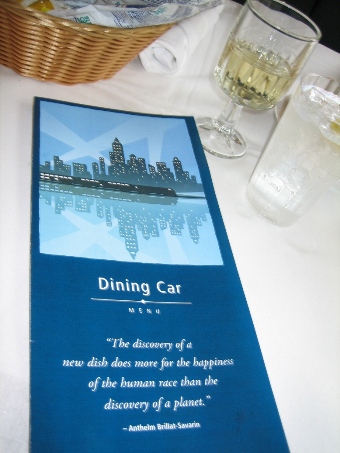
Yes, that’s a quote from famous 18th-century French gourmand Jean Anthelme Brillat-Savarin, author of the wonderful, inspiring and absorbing book The Physiology of Taste. And yes, his name is misspelled.

But it makes me want to weep that somewhere in the Amtrak system, someone even knew enough about Brillat-Savarin to want to put his famous quote (second only to his quip “Tell me what you eat, and I will tell you who you are”) on the front of the menu in diner cars across the country.

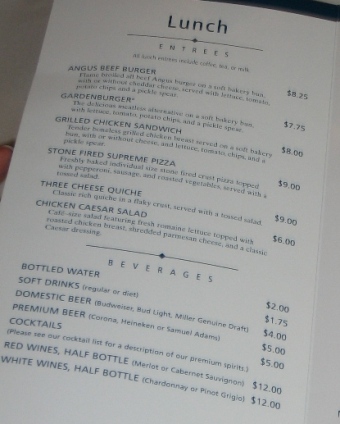
Then it makes me want to weep even more when I open up the menu and see not a brilliant new dish, but many of the tired old ones.
amtrakxxs
You’ve got your burger. You’ve got your pizza. You’ve got your veggie burger (which I actually ordered, and the waitress tried hard to sound enthusiastic about it). Sigh.

If I hadn’t been depressed by all these wasted culinary aspirations, I would’ve been better able to appreciate that the food is actually kind of good, in a standard-issue way. At dinner, things like lamb shank are on the menu along with the pizza and the burger. The last time Peter and I were on Amtrak, a couple of winters ago, we had a quite delicious dinner in somewhat elegant surroundings, and met a very cool painter from Alaska.

This time, we were only on the train for breakfast and lunch, when the menu is in the all-American doldrums, and you only get plastic cutlery. But what the heck, our eggs were fine, and then at lunch, Peter’s burger was actually quite beefy tasting, and my veggie thing was veggie-like. (I really don’t know what possessed me to order it. It won’t happen again.) And then our waitress offered to buy us a cheese-and-crackers kit from the bar car to go with our second half-bottle of wine.

Lunch in the diner–it’s no dinner, but what can you do? Poor Brillat-Savarin, probably rolling in his grave.

Yahoo! Travel: Discovering Mexico’s Yucatan Peninsula

The Rough Guide to the Yucatan gets a moment in the spotlight over on Yahoo! Travel, in this interview I did with Rolf Potts. Assorted travel tips for beaches and ruins, plus what to eat where.

Alas, the update page for the book isn’t mentioned, but it should be: go to www.roughguideyucatan.com for recent changes in the Yucatan. I’ll be adding a lot more in October when I go on my next research trip for The Rough Guide to Mexico.

Arabic: the peril of air travel

This only loosely has anything to do with what I normally write about here, but damn, I was pissed and ashamed to read about Raed in the Middle being given the runaround for wanting to wear a T-shirt with Arabic writing on a plane in the US. (The BBC also covered the incident.)

The gist is this: he was wearing a T-shirt that says “We will not be silent” in both Arabic and English. It’s a T-shirt that people have been wearing to protest totalitarian governments wherever they may be. Free speech, right on.

The FBI guys actually said they couldn’t trust that the English translation was accurate.

So I will say here what he could not say at the time, lest he be hauled off to jail for making threats:

What, you freakin’ idiots, you think terrorists are going to get on a plane wearing T-shirts that say in Arabic, ‘On the count of 3, hijack the plane’?

Now, I know Arabic is very, very baffling, with all its squiggles, and its dots, and its right-to-lefting. But it is not a dangerous weapon that people should live in fear of. I mean, Americans have enough other things to be afraid of, from pedophiles to global warming, to worry about a foreign language making them a little nervous while they’re on a plane.

That’s sort of the message implicit in two T-shirts I recommend buying:

I’m Not a Terrorist: in both masculine and feminine versions, Ts and tanks, black and white, at low, low prices. No English translation, for enhanced jumpiness-making. (Yes, fusha freaks, I know the masculine version isn’t completely grammatically correct, as it lacks its tanween, but what’re you gonna do? Go kvetch on Language Log.)

If that’s a little too ballsy for you (or, hey, if you’re just not 100% sure), then you can go with this:

Rana Hajjar’s cool-font “New York” T-shirts (and OK, there’s Beirut and Brooklyn too–but no Queens, harrumph)

The clever thing about Rana’s shirts is they’re not immediately obviously Arabic. And then someone asks what your shirt says, and you say, “New York. In Arabic.” And then the person looks a little jumpy. And then you look at them with your eyes narrowed, as if to say, “C’mon, really? You’re worried?” And then they shift a little, and smile, as if to say, “Naw, dude, I’m cool. I’m all multicultural.”

Good Christ, get over it, people. And if you’re so freaked about security on planes, maybe you should go work for TSA yourself. Get your training here:

Bomb or Not

Thank you for listening to this public service announcement.

Why Astoria will never be cool: the Eagle Electric building

Not that I want Astoria to be cool, but it does sort of irk me the way Brooklynites write the place off completely. (And Manhattan residents–forget it. The word ‘Queens’ just sticks in their throat, and they start to pass out.)

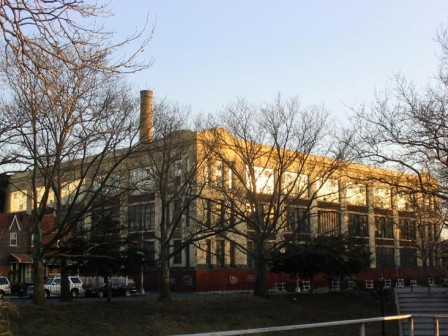
But then I cruised by the Eagle Electric renovation over on 21st Street the other day, and I realized this neighborhood is pretty much doomed–by utter tastelessness. I think there’s more nonironic acid-wash denim on the N train than anywhere else in the city, and it seems developers have the same love of the 80s.

Here’s what the building used to look like:
factoryxs
(Thanks to Bridge and Tunnel Club.)

And here’s what it looks like today (admittedly, from what can only be politely called the backside):
astoria1xs
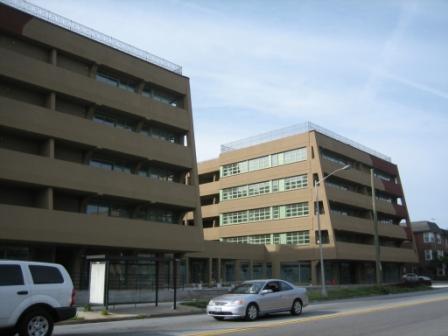
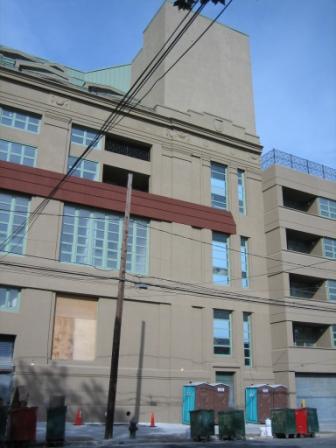
This is so heinous and depressing, this photo alone cannot convey it. This went from being a cool old factory building to a baby-shit brown concoction that wouldn’t have looked out of place on a beach in Cancun in 1982. I have seen such vile resorts firsthand in their native habitat, and I can’t believe someone went to the trouble to build one from almost-scratch here in Queens. Those terraced balconies, that vile stucco, that weird block of darker color to add, I guess, “visual interest.” Such an absolute waste of cool raw space. If there were a Go Fug Yourself for buildings, this place would deserve a permalink on the home page.

Oh, and we haven’t even gotten into how they actually lowered the ceilings in the front half of the building (on the right edge in the pic) to fit in more floors. (Edited to add: Don’t freak out–I know I’m wrong about this, and I say it in the next graf!)
astoria3xs
Pistilli Realty needs to go to remedial developers school. Lesson No. 1: People like high ceilings. Lofts have high ceilings. Therefore, people like lofts because they have high ceilings.

Although I see from an article in the NY Times from 2003 that the scrunched five-story front section was allegedly an add-on to the original three-story building in the back. But that whole lot was built out when I first saw the place, well before 2003, so I don’t know what that’s all about.

But then see this Queens Gazette story from 2000 for a teeny-weeny pic of an earlier rendering, with greater aspirations as to number of floors. Also, I guess the even teenier ‘now’ pic shows that I’m probably being paranoid about the active condensing of floors. Still, it seems retarded, if only because the people in the five-floor section will be constantly reminded of how much space they’re missing out on just half a block away.

(To clarify: this is not the Eagle Electric headquarters down in Long Island City, which is being renovated as Arris Lofts–a bit more tasteful, if also a bit more ridiculous in terms of what the market will bear.)

And can I just add I can’t believe an MF-in’ BANK is going in where Cafe Byzantio was on 31st St and Newtown?! As if the world really needs another one. Can’t we write a zoning law against them? Or say that for every branch you open in Astoria, you have to open two in the South Bronx?

Baltimore: The Saint Francis of Assisi Crab Feast 2006

I knew crabs were a big part of Baltimore, but apparently, they are so important that you get an automatic pardon for taking the Lord’s name in vain in a church basement.

See, there’d been a lull in crab delivery in Hour Three of the S.F.A. Crab Feast 2006, and one of our party had been moved to bellow, “More crabs, God damn it!” while pounding on the Kraft-paper-covered table with his little mallet. The monsignor, it so happened, was sitting behind him, but he only beamed and said, “Keep yelling!”

Not that we were going hungry or anything. Peter knew his way around this feast, as he’d attended one back right after he’d been down here as part of the PO-lice (he still keeps the entrance sticker from the last one in his old wallet with his badge). When we arrived, he took me first to the buffet line in the back of the drop-ceiling basement, where we could load up on tomato slices, corn, three mayo-based salads, hot dogs, pulled-pork sandwiches, and crab soup.

Peter’s old colleagues, his former sergeant and others, scoffed at this lighweight approach, which would surely ruin his appetite for the main attraction. They held out for the first wave of crabs–which were already 15 minutes behind schedule. Peter’s sergeant’s 12-year-old daughter was working the feast, though, so we were guaranteed to get served first.

Also at our table was a partially toothless woman who perhaps had not actually paid for a ticket, but had won an entrance badge simply by plopping down and insisting. The fact that she was a black bag lady made it pretty obvious she wasn’t with our party full of conservative, ghetto-hating cops, but she didn’t seem bothered. And really, neither did the cops. She happily sipped her beer, and smiled vaguely.

When the crabs finally came, she started slipping them into her purse. Eventually it became clear that she actually didn’t know how to clean a crab–unheard-of in these circles–so Peter’s sergeant cracked one open for her in about eight seconds. I was glad not to be the only crab novice at the table, and I felt better getting to watch a second demo, as the one Curtis had given me, the 30-second version specially tailored to Crab Retards, hadn’t exactly stuck.

Another interesting element to the meal, aside from the novelty of finally experiencing a Real Live and Legendary Baltimore Crab Feast, was that this was only the second time I’d met these people, who are from a chapter of Peter’s life I don’t know that much about. They call him “Pete” and heckle him for being a liberal and try to get him to move back to Baltimore. The first time I’d met them had been under very unfortunate circumstances, back when I was getting really sick last fall. We went to another B’more food tradition, a bull roast to celebrate some cop-related thing, and I’d spent the night feeling queasy and mentally calculating the distance to the bathroom or a potted plant, and I was also coughing horribly and worrying about the fact that my ankle was swelling to the size of a baseball. Plus the music was loud and there were tons of people. Oh yeah, and all these people had really, really loved Peter’s old fiancee. So that didn’t go very well.

This time, on a Sunday afternoon in a fluorescent-lit room, with the musical stylings of the Zim Zemelman band (accompanied by the monsignor on trombone) and the alluring tick-tick-tick of the Wheel of Fortune in the background, the social pressure was a little bit less. It was also aided by the simple communion of picking crabs. It kind of reminded me of that part in Moby-Dick when Ishmael is sitting around working the lumps out the whale sperm (not that kind of sperm–read the book!) with his pals, where he gets all loving and affectionate because the stuff is so lovely and they’re all working together as a team:

“I was continually squeezing their hands, and looking up into their eyes sentimentally; as much as to say, – Oh! my dear fellow beings, why should we longer cherish any social acerbities, or know the slightest ill-humor or envy! Come; let us squeeze hands all round; nay, let us all squeeze ourselves into each other; let us squeeze ourselves universally into the very milk and sperm of kindness.”

OK, so it wasn’t exactly like that. (And let me just add, it’s a testimony to how much I love Moby-Dick that it didn’t even occur to me to snicker at this scene until just now.) It was a little harder and prickly, but it was certainly chummy, being up to our elbows in Old Bay, and making massive piles of discarded shells and little spindly legs, and passing the beer up and down. (I guess now that we don’t hunt whales anymore, beer is the new social lubricant.) And I did have that great feeling of all-powerful omnivorousness, where you get to feel so proud for being a clever human with opposable thumbs and sharp teeth and tool-making skills (except the head of my mallet flew off the first time I tried to whack a crab leg with it).

Also, because we had an almost-endless stream of crabs, plus the buffet, the actual dining pressure was off, making it much easier to just talk to people. Slurping and cracking and reaching for beer, we were a sloppy, merry bunch, united in our dedication to sucking as much sweet meat as possible out of these recalcitrant sea creatures–and ocasionally checking our raffle tickets to see if we’d won at the liquor table. It was also just enlightening to hang out with Republicans, since of course in New York these are feared and loathed people swathed in legend and lore, but rarely seen in the flesh.

Despite the grousing about perceived crab scarcity, and the price of tickets, we all went away satisfied. I had managed to finesse my picking skills with each new crab, I’d argued politics a bit (beerily), and I came away feeling like I was no longer just the surprise wife who’d replaced the good fiancee. Thanks, sweet crabs.

Alex Witchel–the human face

During July, I slacked on the Witchel Watch, and had pretty much forgotten all about her and her annoying tendency to write about shallow socialite eating (or not-eating) habits. So it was a pleasant surprise to open the NY Times food section last week and start reading an essay, then realize it was hers, then realize it was not so terrible after all.

See, in this essay (“Childhood Was Just Around the Corner”), she talks about her life pre-social status. Turns out she went to Zionist summer camp for six years straight, which sounds to me like just the recipe for making you hate food for the better part of your life.

The weird thing is that she actually hankers for food from that era, which all sounds bland and white in her description, but I guess we all have our strange imprints (right now I really, really want an Italian sub from Sam’s in Seaside Park). The nostalgic-look-back-at-childhood-food theme is a bit of a tripe, I mean trope, but she does it with humor and self-deprecation, and a nice twist. And she made me consider white pepper in tuna salad, which is a little funky.

The long-term problem, though, is that Witchel has just one childhood to mine for essay material, but countless dull socialite dinner parties to attend in the future. Here’s hoping she keeps looking back.

Sea Urchins in Greece–finally

My days in Greece went something like this: wake up, put on bathing suit, make some random plan for going somewhere, walk down to the hotel lobby, and encounter someone else who will change my plans completely. Sometimes that was good, and sometimes it was very, very good.

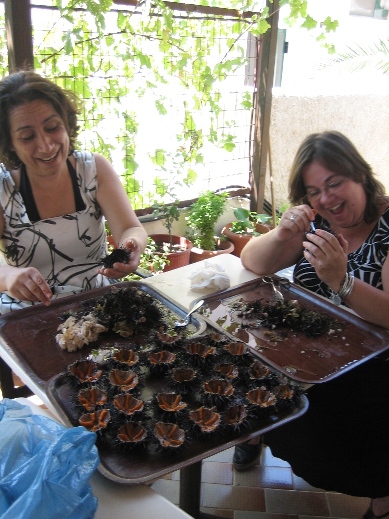
The sea urchins were one of the latter cases. When I walked downstairs, I looked out on the veranda and saw Fani, my godmother, hard at work with a couple of her friends.
Urchins1
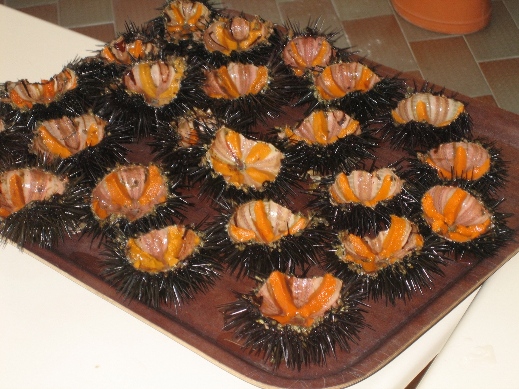
The funny thing was just how merry she looked about what seemed to be a really disgusting enterprise. They were cleaning a big tray of sea urchins. That involved, Fani explained, cutting out the soft “eye” on the bottom with scissors, then scraping all this brown jiggly goo out, while leaving the good part intact. All this while not stabbing yourself with the pointy bits.

They did look beautiful when they were done:
Urchins2

I’d never seen the inside of a sea urchin, and the only place I’d encountered the stuff before was as a big jiggly orange blob on a plate in Japanese restaurants, where it has come to be the ballsiest thing to order after chicken sashimi. I once read a (favorable) description of eating sea urchin as “like going down on a mermaid.” This whole sexier/cooler/bad-asser-than-thou posturing has no place in food, I think, and the one time I ate sea urchin, I was annoyed at the gung-ho attitude at the table. Maybe I was just being contrary when I said, “Enh.” Like a lot of Japanese food, it seemed to be a lot about the texture–or whether you can ignore the texture, which is silky and slithery and a lot like barely cooked brains.

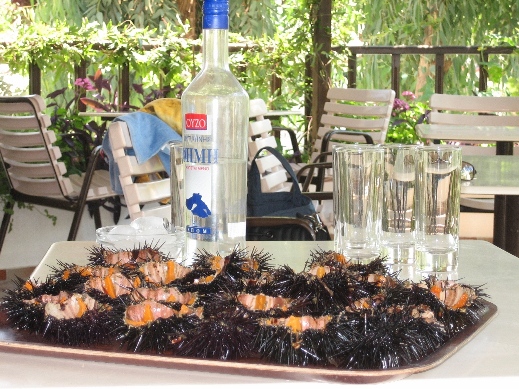
But seeing these little sea urchins in their natural state, as sparkling orange stars laid out in black shells, I could see the appeal. They looked even more appealing when placed next to a bottle of ouzo:
Urchins3

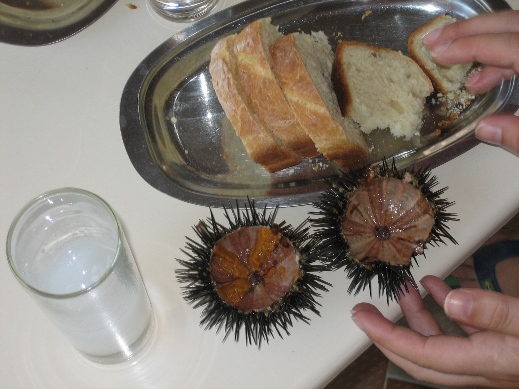
The other accompaniment was fresh-baked bread, with which we were to scoop out the insides.
Urchins4

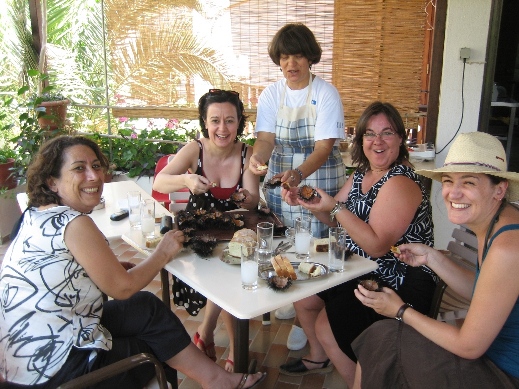
So, we dug in. The orange goo, smeared on the bread, was sweet and salty, delicate but also unmissable. It got a little more missable as I drank more ouzo, but before that, I was astounded by the tender, full flavor.

I was also touched at the extent to which humans will go to find something tasty. Around the table there was a glee that could not be credited completely to the ouzo. It was also sheer delight that we humans had once again succeeded in foraging. We had used our exceptional cunning to find, in the most unlikely of places, something not just edible but delicious. We’d won against these sea urchins, and that was cause for celebration.
Urchins5

Just a few weeks later, I got the same feeling at a crab feast in Baltimore, but that’s yet another story.