AV‘s brother has sussed out an excellent example:

Read the whole post here, with another pic.
He saw it while at the new Menudo auditions. (Working.) Honest.
AV‘s brother has sussed out an excellent example:
Read the whole post here, with another pic.
He saw it while at the new Menudo auditions. (Working.) Honest.
Copy edz sumtimes luvz bahd grammerz–lyk rilly!
I jus bin wallowin in teh kittehz. Heer sumz fudz laffs 4U:

kthnx.
[more lolcat here. be very careful. only now regaining use of spelling. capital letters will come. breathe.]
I guess it’s the upcoming Cairo trip, but I’ve been in a very nostalgic mood recently. In preparation for another project that’s brewing in my head, I’ve also been thinking more carefully about how I learned to cook. I owe a lot of it to one book.
Back in February, when the nostalgia was first starting to swell, I was overcome with an urge to cook Indian food. Whenever anyone asks me what my specialty is, I shrug and say Indian, even though I haven’t cooked it in years, and I could tell you less than Wikipedia about the history, culture, roots, etc. of it. I’ve never been to India, and I have no ancestral connection to Southeast Asia whatsoever.
But in culinary-education terms, India is really where I started out.
I find it hard to believe that I haven’t bitched about my broke winter in London on this blog, but here’s the summary: 1994. Demoralizing job. Nasty boyfriend. Awful roommate. Chronically cold. Nescafe. Drunks galore. No money.
So, because we couldn’t actually afford to go out and see London, my boyfriend began cooking dinner (a single saving grace). He picked up a copy of Madhur Jaffrey’s Indian Cooking, and when we broke up, I got the book.
Actually, now that I’m telling this, I’m a little shaky on when that book entered the picture. London was a blur of bad weather and “bacon misshapes”from the cheapo bin at the butcher, but I’m pretty sure Madhur was already there, a steadying force that sensibly broke down a highly complex cuisine into the basics: Toast spices. Make ginger-garlic paste. Fry. Commence with particulars.
After London, I moved to Bloomington, Indiana, for grad school. Madhur got some stained pages that year–the ex had been extremely finicky about books, so I took satisfaction in breaking this one in. The next year, I moved into a huge house with three other people (far better boyfriend, exceptionally good roommates), and whole chapters were made greasy and sticky for posterity.
Sometime during that second year, when I got truly-o sick of medieval Arabic poetry, I started reading Cook’s Illustrated, which I still heartily recommend for anyone who wants to really understand why cooking works. But it wasn’t until I got an issue with a story about curries that I realized what a clash of civilizations I’d waded into.
Nearly every paragraph had some variation on “that’s not how I learned it in France”–pretty condescending by the third column. I could practically see the editors shaking their heads in wonder that this curry business worked at all, what with not browning the meat, and not thickening the sauce, and throwing spices in hot oil, and all that crazy business.
I guess knowing “French technique” is important. I owe them for my gravy-making skills, even if my dad never presented it to me in those terms, and the concept of white sauce (‘scuse me, bechamel). And boiling down wine is a good idea.
But my life was a lot happier, in a dippy “It’s a Small World After All” way, before I realized how the French barreled in and declared themselves the boss of food. The Italians managed to sneak in before the kitchen door swung back, but it’s still a ridiculously narrow selection when you consider just how many delicious things there are to eat all over the globe.
Years later, when I was considering going to cooking school, I had a hard time finding one that gave more than lip service to cuisines that didn’t rhyme with Wench and Vitalian. I wasn’t too excited about joining a cult that looked at Madhur Jaffrey and said, “Weird!” and not, “Wonderful!”
At one esteemed institute, I sat in on a class about risotto. The guy was explaining how you have to stir to release the starch. I piped up, “Cool! It’s exactly the opposite of a good pilaf, or a biryani, where you rinse all the starch off to start with, and make sure not to jostle the rice at all.” Crickets. Shuffling feet.
My fascination with Indian food started to fade away sometime in 2000. I’d gone freestyle–I could honestly say, “I’ll just pop into the kitchen and whip up a curry!” Not only had I met the challenge, but at that point the Madhur Jaffrey book, and everything I’d learned from it, was associated with two dead relationships. It was time to move on.
I’ve cooked a lot of other food since then, but nothing has given me quite the same thrill of discovery. That single Indian cookbook taught me not just no-fail Potatoes with Sesame Seeds (p. 114), but also how to look at every cuisine as a series of techniques: the same steps that every woman (probably) has been doing for centuries, usually while seated on a kitchen floor and slicing into her hand with a dull knife. The differences aren’t only in ingredients, but in how you slice your onions, whether you add meat stock or water, whether you cook something in a sauce or add the sauce after.
I also learned some skills that apply whatever you’re cooking: Measure the fiddly stuff before you turn on the heat (the French didn’t invent mise en place). And clean as you go, because crusty ginger-garlic paste is a bitch to get out of the blender.
When I opened up Indian Cooking again this February, it flopped obediently open to a grease-spot-dappled spread for The Lake Palace Hotel’s Aubergine (Eggplant) Cooked in the Pickling Style. Page 75, Lemony Chicken with Fresh Coriander, is distinctly yellow, thanks to a little turmeric fiasco. Cauliflower with Potatoes, which made an Indiana roommate named Wayne say, “Whoa, dude–it’s like cauliflower, but funky,” is marked with some mysterious crunchy bits.
The strongest proof of just how way-back these recipes go with me came when I was whizzing up my first batch of ginger-garlic paste for that February meal. Peter, who now seems like he’s always been around, looked in and said, “What the hell are you doing in that blender?”
Fortunately, he didn’t sound like a snooty French chef when he said it. And he loved the eggplant.
————-
Since the Magic Book is now out of print, I feel like I can in good conscience copy (loosely) a recipe here. It’s basically the same as what’s in the book, but frying eggplant is tedious and grease-consuming, so I now roast the eggplant in the oven instead.
LAKE PALACE EGGPLANT
adapted from Madhur Jaffrey’s Indian Cooking
Preheat oven to 400 degrees.
Slice up
1 large eggplant (approx. 1 3/4 lb.)
into wedges about 3/4-inch thick and lay on a cookie sheet; drizzle generously with vegetable oil. Roast eggplant in the oven, turning once, until the pieces are soft and lightly browned. Drizzle on a little more oil if they’re looking parched. When they’re done, take them out and set aside.
While the eggplant is roasting, throw in a blender or food processor:
1-inch cube of fresh ginger, peeled and chopped into a couple of pieces
6 cloves garlic, peeled (or more, but not tons more)
1/4 cup water
Whiz up till you have a smooth paste.
Also, measure out your spices. In one small cup, combine:
1 tsp whole fennel seeds (or a little more, if your spices are old and tired, or you just like fennel)
1/2 tsp kalonji (black onion seeds) or whole cumin seeds (kalonji is good, but don’t beat yourself up over it)
In a separate cup, combine:
1 tbsp ground coriander seeds
1/4 tsp ground turmeric
1/8 tsp cayenne pepper (more, if you like)
1 1/2 tsp salt
Put both bowls close to the stove.
In a heavy saucepan over medium flame, heat:
3 tbsp vegetable oil
When it’s shimmery, toss in the fennel and kalonji/cumin. After they’ve darkened slightly (just a few seconds), pour in:
3 medium tomatoes, peeled and chopped (canned ones work fine, but make it 4 in that case)
along with the ginger-garlic paste and the other cup of ground spices. There will be a bit of spattering. Let it all simmer, stirring a bit, until a lot of the liquid is cooked away, and the the whole thing looks pastelike–this takes 5 minutes or so, depending on how high you have the flame set.
Now put in the fried eggplant slices and mix gently. Cook on medium-low heat for about 5 minutes, stirring very gently. Cover the pan, turn heat to very low and cook another 5 or 10 minutes–this makes all the flavors meld.
Serve hot or cold. Serves 6, if you’re lucky.
I’ve been mentally compiling a collection of images of animals eating themselves, all in the name of stoking your appetite. But now it looks as though someone has been actually doing it. And front and center is an especially ghastly–yet adorable–image I already had in my brain file from months ago. Classy.
Et voila: Suicide Food.
Peter found another to add to the portfolio while biking around New Orleans.
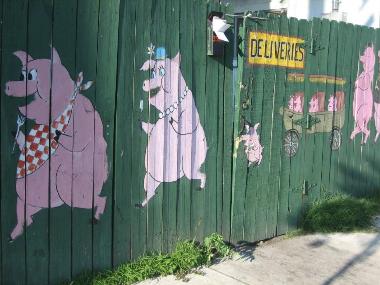
Adorable. In fact, so adorable, let’s zoom in a little and take a look at those piggie-wiggies.
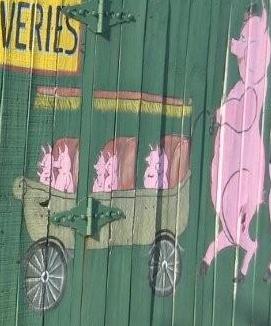
This does beg the question: Is it really ethical to roll your little pig children off to be eaten? It’s not suicide food in the typical sense. But if getting made into barbecue is so much fun, why would you deprive the wee ones? Especially when you know they’ll taste so delicious!
Too bad this restaurant — Elizabeth’s, in the Bywater — was closed. Next trip.
[Thanks, Polenblog.]
Tomorrow Ali’s running off to Egypt (where I’ll get to see him!) for a month, then doing some major renovations on the restaurant when he gets back, so he’ll probably be closed till mid-June or so.
I am so relieved I know about this in advance. Last time he shut down for a long stretch, it was extremely traumatic.
In the meantime, it’s a good excuse to go down the street (25-22 Steinway) and eat at Mombar, his brother Mustafa’s place. But don’t go getting used to the elbow room!
First: no green-pepper showdowns on the mean streets of the Crescent City. In fact, the only time I got even a hint of the stuff was in some alleged lobster oil floated on some cucumber soup, but by then my taste buds were so fried by, well, fried food that I could no longer judge. (More on that later.)
The second most important thing: New Orleans is a fabulous place to ride a bike. The fact that I’m mentioning this before the food is saying a lot. It has been a long winter, and I’m a little bike-deprived, so that may account for some of my enthusiasm. Another big asset: We had excellent guides in the form of Dan Baum and Meg Knox, who advised us on everything from where to rent the two-wheelers to which streets had the worst potholes. (Yes, the very same Dan Baum whose New Yorker blog I was admiring just a week ago. Lordy, I love the Internet.)
But in addition to all that, New Orleans is mostly level ground, completely anarchic without being crowded (read: I don’t have to follow traffic rules), and every person you pass has a little something to say, often about your hat. I’m sure in some neighborhoods, at some times of the night, the commentary from the sidewalk might not be so heartwarming, but this trip really reminded me why a bicycle seat is the best space to inhabit as a tourist. And certainly a bike is ideal for 2007 New Orleans, where you have this prurient interest in seeing just what the place looks like post-horror, but don’t want to seem like you’re staring. A bike goes a polite speed, a tactful speed.
(For the record: it is still a disaster, even though/because it’s not in the news much anymore. The trauma is palpable. Everyone wants to talk about it, but no one has anything else to say. It’s a strange place to be a tourist. Compare with Cancun, where everyone sports “I survived Wilma” T-shirts and laughs a lot; only the stubby palm trees are a clue that the biggest hurricane ever in the Caribbean landed here, not long after Katrina hit New Orleans.)
OK, OK: the food. Knox-n-Baum were also fine tour guides in this department, but we also got pointed to a sweet shrimp po’boy by a random dude on the street, which is proof that New Orleans really is an eatin’ town. If I asked a New Yorker for a restaurant recommendation, he would never give up his favorite place, and the place he pointed you to just at the end of the block would be some pretty crappy diner.
First night out, we gorged at Cochon, due to its proximity to where we were staying and its featuring calas on the menu. Not that I could actually remember what a cala was, but I did remember having clipped a recipe from a Slow Food magazine many years ago. (Oh, guess what? It’s something fried.) Cochon struck me as doing just the right amount of fancy-ifying of the Cajun and Creole oeuvre, but I’m not some kind of expert with standards of authenticity to offend. I pretty much bet there was no cream-of-mushroom soup at work back in the open kitchen, but there was of course a lot of bacon, and some succulent little ribs, and some sweet-and-smoky collards. Also some really buttery oysters. It was a bit of a blur due to travel daze and chatting with KnB and loads of small plates.
Next day…also a bit of a blur. Fried shrimp. Fried oysters. Root beer on tap at the Rock ‘n’ Bowl. Some soft-shell crab. Some eggplant and crab in a spicy cream sauce in capers, which made me realize what’s so genius about food in Louisiana: It’s all the completely unapologetic richness of French food, with the kick in the ass of spicy heat. It’s probably the only place at that near-tropical latitude that consumes so much butter and cream. Sounds like a recipe for disease of some kind, but damn, it tastes good.
Saturday: more fried oysters. Some fried catfish. A cherry Danish. Zapp’s potato chips in limited-edition Tabasco flavor and “craw-tator.”
And then: The Wedding! The whole reason we were there, and the reason Peter (aka Recently Made Reverend) was wearing such a snazzy hat. Jim and Daphne tied the knot, to tearful toasts, terrible limericks and Led Zeppelin. I haven’t been to such a solid costume party in years, aside from that thing in the desert outside Reno. And I don’t think I’ve ever had such good food at a wedding. I rounded out my day with some fried chicken, plus a solid helping of collard greens. And the cake was scrumptious–by the pastry chef at Lillette, where I was sorry we didn’t get to eat. Oh, then a late-night bite of a grilled pork chop from an especially crazy grill contraption.
Sunday. I was so beat by biking against the wind (sing it, Mr. Seger) to get to the Single Ladies Pleasure Club’s second line that not even fried oysters and shrimp on the same bun could get me back in the game. A few bites of a smoked sausage bought from a grill mounted in the back of some guy’s truck helped a little. But even a couple of Pimm’s cups didn’t provide the refreshment I needed. Nor did a glass of red wine with ice in Tamara and Karl’s hotel room. (Yes, we take them everywhere we go!)
So by the time I tottered into Restaurant August, nearly the poshest spot in town and probably the only reason a random Google-r will land on this post, I could barely face a single plate of food.
Yes, I had a Campari. And fizzy water. But I really needed some Roman-era purging treatment. Peter had a five-course tasting menu, and I picked at my beet salad. Even asparagus soup seemed too rich, and a nibble of lamb nearly killed me. That’s when I thought I tasted green pepper in the lobster oil. So really, who knows?
Oh, but it’s good to be human–for what did I have the very next afternoon, as our plane took off from Louis Armstrong International?
A shrimp po’boy, of course.
Oh. I guess you can be a travel writer and not kvetch constantly. Amanda Castleman does just that on Road Remedies.
To-do list for tomorrow:
1) Report on green peppers in New Orleans.
2) Report on fried oysters in New Orleans.
3) Report on fried shrimp in New Orleans.
4) Report on disappointing hitting of wall, appetite-wise, on Sunday night in New Orleans.
5) Recalibrate overall attitude. Life is pretty good.
Oh, except for my lament that I can’t show you a picture of the package of udon noodles we had in the fridge but threw away too soon: “Ingredients: Unbreached white flour…”
I pretty much like all foods. I mean, almost. After I got over cilantro tasting like dish soap, and beets tasting like dirt (they still do, but now I don’t mind), the only thing left that I really don’t like to eat is:
Cooked green peppers. [horror-movie reverb font]
They remind of school lunch. Even at parts per billion, they manage to contaminate a whole dish, and make it taste…cheap, or something.
So I’m feeling a little anxious about going to Cajun-land tomorrow, where every recipe seems to start, “First, you saute your green peppers…”
There’ s a major disconnect here: I can’t imagine that an entire cuisine is actually going to be disgusting to me. I mean, it has hundreds of years of tradition and love behind it–how can it be bad? How can it really taste like spaghetti day in 1981 at A. Montoya Elementary?
But what if I’m served a big bowl of gumbo by some smiling old woman, who’s been slaving at a hot stove for decades…and I really just don’t like it?
I’m keeping an open mind. Believe me, I want to shake this negative association. I assume it’s just like getting used to guitar feedback. I just need to eat the Pixies, rather than, say, Whitesnake. Uh, right?
Meanwhile, this new post from Dan Baum, complete with photos of plump fried oysters, convinces me I’m doing the right thing by going, and facing my demons. It’s not like I’ll starve.
(Also, a Google map I made, based on assorted recommendations–any other suggestions?)
Now that I have some very steady freelance editing gigs, I don’t wind up seeing as much of the city as I used to, when I was scrambling all over town from month to month. But just this week I happened to take a job located in the new 7 World Trade Center building.
Never mind the Jenny Holzer installation in the lobby, the high-tech elevators that convince you no one but you works in this building, the staggering view and light from way up here, the weird perspective onto Ground Zero, where I could watch the toy-size backhoes doing K-turns all day long, and the fact that I can look out from the 29th floor and see carved stone elephant heads adorning the building next door.
It’s just invigorating to come up out of the subway in this area, with the air crisp and the buildings soaring up, and everyone looking busy busy busy. In my little Queens bubble—which is all about immigrant NYC, and that energy (and my own personal sloth)—I’d forgotten about this kind of NYC energy: humming financial engines, strong architecture, the fact that we’re all on a little island that humans have completely, ingeniously covered in stone and concrete, like a scab.
Meanwhile, inside the building, I’d also forgotten about office culture…or at least a whole new set of quirky behavior under fluorescent lights. And because everything at this office is perfectly gleaming and new, I feel all the more like I’m on a TV set. It’s great to be able to walk into a totally new world for three days, and then walk back out.
Incidentally, it seems like everyone is always eating here. All day long, I hear the rustle of candy bags being torn open, the pop of deli container lids, conversations about where to get sandwiches. I guess it’s part of settling into a new space, getting to know the neighborhood, sorting out what’s stocked in the corporate fridge (seltzer water—classy!).
Or else it’s just time for me to eat lunch.
Saturday night I went to Ali’s Kabab Cafe for dinner, by myself. It feels like it’s been a while since I’ve been there. There was something about being alone, and for once not seeing anyone else I knew, that reminded me of when I first moved to New York, and Astoria. I just sat there and read a little, and occasionally stared mistily into space, thinking of…geez, nearly a decade ago.
Back in 1998–or maybe it was 1999 by the time I got to Kabab Cafe for the first time–Ali’s felt like a little airlock between New York and Egypt. Not that I missed Egypt exactly (here’s one reason why), but I still felt a little out of step with glossy, consumer-y NYC, and I needed a little more dim lighting, hot tea and weepy Umm Kulthum music in my life. In those early days, going to Kabab Cafe felt like I was visiting a foreign country again, one whose GDP was based on nostalgia, atmosphere and clouds of sheesha smoke.
Now I know half the other regulars, Ali and I are friends, and he doesn’t smoke the water pipe in his place anymore. Almost nine years have slipped by since I was in Cairo–and now I’m set to go back again, in less than a month.
Last time, I was there for a year doing the Center for Arabic Study Abroad (CASA). Not only was Arabic irrelevant to Americans back then, pre-9/11, but the social shenanigans of twenty wacky students in the pressure-cooker of Cairo were utterly wasted, because reality TV hadn’t been invented. This would’ve been ratings gold: mix medievalists up with political wonks, throw in a few Mormons, shack us up in grand, decrepit apartments with dusty chandeliers, and make us all sit in class together for eight hours a day. Weirdly, I am still friends with a good portion of these people.
This time, I’m going to update a guidebook to Egypt—a job I’m now feeling like the 25-year-old me should have done. In my preparation for the research trip, I’m finding it very difficult to brush away all the emotional associations and remember the details that might be relevant to a traveler who’s not sucked into a yearlong process of ego destruction via high-school-style social snubs, recurring illness and failure to grasp the infinite subtleties of Arabic grammar and vocabulary.
Such as: Men will harass you like crazy on the street. (Mental note: Buy more sports bras. Breasts must be locked down.)
And the gauntlet of cab drivers at the airport—it’s like the paparazzi, but not. Know where you’re going, and how much you’ll pay.
And it’ll probably already be crazy hot. And pack Kleenex—the smog makes your snot run black at the end of the day. And be careful crossing the street (especially careful this time, with my now-blind eye).
As you can see, I’ve been slowly building up to a full panic. It’s a very specific version of a broader pre-trip anxiety that always seizes me, no matter where I’m going (this Thursday: New Orleans, where I will certainly miss Jim and Daphne’s wedding because I will have been mugged and shot and left in the middle of a potholed street).
I’m trying hard to think positive. Normally I would do that by thinking about food.
But Cairo is a difficult place, food-wise. Not only is it not exactly bursting with deliciousness, but my gut flora were so traumatized by my decade-ago visit that my stomach still lurches a little when I think of, say, tabbouleh on a hot summer night. (Why did I eat that? No sane Cairene eats parsley salad in the summer.)
So I think it was my solo visit to Ali’s that warmed my heart a little, and created room for the barest flutterings of excitement as I was flipping through guidebooks today: al-Tabei, that place with the super-garlicky marinated tomatoes; Fatatri al-Tahrir, where you can get a flaky “pizza†topped with jam and coconut and nuts; kushari, the lentils-n-rice topped with a zingy vinegar-tomato sauce; even those 20-cent mashed-potato sandwiches with the crunchy bits of cilantro; and the chicken livers and French fries at the Odeon bar.
After that, I run a little dry in the restaurant department, but now, in my reverie, I’m on to bars and clubs (Atlas in 1992, my first trip, now that was a scene, and that upstairs joint where the Sudanese prostitutes hung out) and then, most important, my salvation in Cairo: grocery shopping.
The shiny-clean milk store. The corner shop where I realized, after months, that I could buy eggs in any number I wanted, rather than base 12. The master orange-juicer down the street. The neighbor greengroceress who heckled me for not being a regular customer. The creak of donkey carts laden with cactus fruit and mangos rolling past my window.
There’s plenty more. But no one wants to read Zora’s Proustian Guide to Cairo. I’m glad I’ve arranged a long visit—the whole first week will likely be spent getting all those Masri madeleines out of my system.
And then the next week, I’ll be back to beating off the street lechers with a stick, fighting with cab drivers, stomping up stairwells to fleabag hotel after fleabag hotel and cringing in horror every time I blow my nose.
Yallah—off we go.