Author: zora

Cairo: Great Expectations

The handy thing about imagining the worst is nothing is ever as bad as you think. Cairo is nowhere near as crowded as I remember–although I haven’t yet ventured downtown or into the medieval section in the middle of the day. The trees are actually green, rather than brown–which might be due to recent rain that washed them off a little, but I’m not complaining. No one has said or done anything sleazy to me. And when I say ‘No, thanks,’ people actually leave me alone.

This is all a little weird, frankly. And I’m sure I’ll wind up completely reversing these statements within the week, but in the meantime, I’m enjoying being pleasantly surprised.

Last night I had the good luck of seeing the Famous Ali in his natural habitat–if not his native Alexandria, then at least here in Cairo, schmoozing with the waiters, chatting up the shisha-coal kid, etc. Just like home, really, but in Arabic. One more thing to add to my list of pleasant surprises–when we were out at 1am on what’s basically Sunday night, I was not at all the only woman hanging out smoking shisha. I’d like to say times have changed, but it occurs to me that when I lived here, I never went downtown on a Sunday night, so how the hell would I know? l guess l shouldn’t be surprised that it’s much more fun to be a tourist here than a depressed grad student.

Reports from Air Koryo

Oh goody–someone is blogging with obsessive detail about his flight to North Korea! After my Air Cubana flight, which was, to quote Heidi, “the fastest bus I’ve ever been on,” I’ve been curioius about the world’s more marginalized airlines. Curious–but not enough to actually fly them.

Meanwhile, Paul Karl Lukacs on Knife Tricks is reporting thusly:

Air Koryo is a flying circus featuring strangely coifed, vampiric flight attendants who work in a cabin straight out of a 1970s’ airport movie while travelers read palpably insane propaganda as they jet to an isolated dictatorship which is officially governed by a dead man.

He just got back from the trip, so presumably more detailed reports from the ground to come as well.

Dave Prince has done it again…

I am so happy to know someone who is so excited about the opening of major grocery stores that he takes nearly 150 photos of the occasion. I only wish he’d call me and tell me. But I guess the big day for the fantabulous Whole Foods on the Bowery wasn’t any secret.

See his beautiful photos here. By about page 8 of the flawless stacks, you will find yourself in a restful, trancelike state.

After that, you can look at equally beautiful photos from Mercat de Sant Josep in Barcelona. The stacks of severed, skinned lamb heads are also soothing, somehow.

(And, in case you missed the first time around: opening day at the Red Hook Fairway.)

I love groceries.

Ciao Bella Gelato at New Town Coffee House

newtownThis new takeout joint on 31st St. just north of 30th Ave. would be pretty unremarkable, except for the fact that they sell Ciao Bella gelato–about eight flavors, by the scoop, for $1.50 a pop. Although it’s not quite as fresh as it ought to be (I wonder if I’m the only person who buys it), it’s still a vast improvement over B-R around the corner.

Also, they have a sign I really like, for its retro flair. But I suspect the owners of the place don’t consider it retro.

And on the ice-cream tip, rumor has it that a new sweets place will be opening on Ditmars, from the guys who brought us Tupelo and the lovely Sparrow bar. A very delicious NYC-made ice cream will likely be available there.

How I learned to cook, part 2–or, I heart/hate Cairo

You already know about my troubled relationship with Cairo. But I do have to admit that if I hadn’t spent the better part of a year whimpering on the bathroom floor there, I wouldn’t be half the cook I am today.

I couldn’t eat in a restaurant there. It was just too risky–who knew where the bacteria lurked? At home, I could douse my veggies in mild bleach solution, and cook everything till the toxic critters expired.

But what to cook?

The year before, in Indiana, I’d become pretty proficient in the weeknight dinners–but that was when I had a Kroger and an international-foods mart both within walking distance. I’d look through one of our 15 cookbooks, and then pop out and buy the stuff I needed. We could buy just about anything, except maybe a whole goat.

Now Cairo is cosmopolitan and all, but the groceries are a little more…limited. In my immediate neighborhood, I had splendid tomatoes, cucumbers and eggplants, and all manner of fruits–but no brown sugar, for instance. We only got that once Livia made friends with a State Department guy, who would buy it for us at the commissary.

So this was my first time cooking with severe constraints on ingredients–after some early frustrations, I finally figured out I had to work the opposite way from Indiana: shopping first, then figuring out what to cook. Turns out this is what everyone in places with good produce does, and what I tend to do more now. At the time, it was a major paradigm shift.
moosewoodFortunately, Livia had brought a very useful cookbook with her: The Moosewood Restaurant Cooks at Home. The essential constraint of that cookbook–no meat!–happened to dovetail very nicely with my own needs that year. Even once my Arabic got better, I didn’t really feel up to the task of going down to the butcher and having him hack me up some flesh. Now I’d relish that, but then, it just seemed like too much of my limited energy to expend in the name of dinner. Vegetarian it was.

I made cucumber-and-tomato salads. I made just-cucumber salads, and just-tomato salads. I made ratatouille. Livia made this great eggplant with tomato sauce and hard-boiled egg.

The things that really kicked us out of the familiar produce rut, though, all came from the Moosewood people. Quick-pickled green beans with dill. A great dish of bulgur, dried apricots and dill, with wedges of feta cheese and tomato on the side. Beautiful-looking and nourishing–even if the “feta” was this strangely creamy Parmalat-box stuff made from water buffalo milk.

Another pilaf recipe called for dates and cinnamon and almonds. It was meant for rice, but since I had lots of bulgur left over from the other thing, it seemed only logical to use that instead. That year, I got very good at dissecting recipes–cutting out the flavors I wanted and attaching them to some other ingredient I wanted, for a sort of Frankenstein dinner.

And it was that year that I first realized how limitations are the best drive toward creativity–imagine The Five Obstructions, but with food. More like The Five Ingredients.

I was also horrifically depressed that year–not just violently ill, but freaking out about how I’d left my boyfriend back in the States, and how I really, really hated studying Arabic, and that it was definitely the end of the line for grad school…but then what? In times of extreme crisis, I pulled myself off my tear-sodden pillow and consulted the dessert section of Moosewood at Home.

Thank Jesus and Muhammad both for Moosewood Fudge Brownies and Six-Minute Chocolate Cake. The first required a single pan to turn out gooey, super-rich chocolate squares; the second was a miracle–a truly tasty cake made only with dry ingredients and a little bit of vinegar. You could even feed it to a vegan, if you needed to.

And I think it was a Moosewood recipe–the really basic Pasta Fresca–that made me go looking for basil. In Egypt, basil is not a food–it’s a plant you grow on your balcony to keep the mosquitoes away. We had one of our own for a little while, but it quickly withered and died. A little while after that, I happened to notice a big bush of it growing in a parking lot on my way to school. It was a little dusty, but it was definitely basil. All through the next seven hours of Arabic classes, I was thinking about basil–a sixth ingredient!

On my walk home, I stopped and snapped off a bunch of it. If I hadn’t already been the crazy khawagaya (Egyptian for gringa) already, that sealed the deal. The parking-lot attendants, with their droopy uniforms and empty machine guns, laughed and laughed–probably because they’d been taking a piss on that bush just a few hours earlier.

But whatever–that’s what mild bleach solution is for. After that, I paused every few days to pick basil, and it added a little extra interest to the cucumber-and-tomato salads, to the various eggplant things, and to a pasta dish I began to eat a few times a week: I made a basic tomato sauce, with lots of garlic, then stirred in a bit of that buffalo-milk feta, and all the chopped-up basil. Toss and serve.

What a luxury now, when I think back–to always have good-quality fresh tomatoes at your fingertips. It makes me wonder why I went to such lengths to get any other ingredients. In one of my last Arabic classes, our teacher asked us all to give a short presentation on what we’d miss most about Cairo. I talked about the produce.

About nine months into the year, my stomach was fairly stable–and I honestly think my regained health was due to the fact that I began drinking heavily and frequently. Whether it killed the bugs in my gut, or I was just less of a stress case, I don’t know, and I don’t really care. Never mind that cooking was an exciting process that drove me into exciting foraging situations and small triumphs nightly… It was also a way to save money–money that I could spend on booze.

Thoughts on the Farm Bill

A while back, I posted a portion of Dan Barber’s editorial on the Farm Bill.

Now plans for the new bill are getting a little more concrete, and the editorials are a bit more frequent. First, Michael Pollan wrote a sensible, succinct piece for the New York Times Magazine, last Sunday, “You Are What You Grow.” As usual, he cuts to the essential problem in a very tidy way: Twinkies, calorie for calorie, are cheaper than carrots, which makes no sense. Produce prices have risen 40 percent over 15 years, while soda prices have dropped 23 percent. This is all due to the Farm Bill’s support of large-scale commodities farmers, rather than farmers who actually grow immediately edible food.

The Albuquerque Tribune also has a nice editorial, “Food Fight,” by Daniel Imhoff, which gets into the politics of the bill a bit more. It also points out (I didn’t know this) that about half the money from the bill goes to food stamps, school lunches and similar programs.

So there’s this nasty irony that if the antihunger people want to preserve food stamps, they have to get together with the large-scale farmers–who are getting a grossly disproportionate amount of the money, and who then produce soy, corn, etc. to make the super-cheap food that makes people on food stamps fat and diabetic.

Now is the time for cranky letters suggesting that Farm Bill money be used to encourage food crops, rather than commodities crops. Contact Hillary Clinton, Charles Schumer and (if you’re in Queens) Carolyn Maloney.

Here’s a suggested outline for a letter you could send (just scroll past Bono at the top).

Rock on, Mr. Dinosaur!

While I’m busy worrying about crossing the street in Cairo, someone I know is actually doing the Mongol Rally this summer. That involves driving all the way from London to Mongolia, in a tin can. But you get a special exemption to the one-litre-engine rule if you do it in an extremely weird vehicle, like a cherry-picker.

Haven’t picked a favorite to back yet? May I recommend Josh’s team, Mr. Dinosaur? Don’t be put off by the fact that they still haven’t got a vehicle–they’re relying on the whims of eBay UK. I urge you to contribute with cash donations–they will need them to donate to charities, as well as to buy cartons of cigarettes and buckets of whiskey with which to smooth their passage through the ‘Stans.

Josh is a fellow copy editor–so you know he’s reliable. And hopefully good at creative problem-solving…

The race begins July 21.

Zwack Attack

Americans, you have no idea: Zwack is here. Brace yourselves.

What is Zwack, you say?

[Thunderclaps. Doors slamming. Locks bolting. Distant screams, and the lights flicker.]
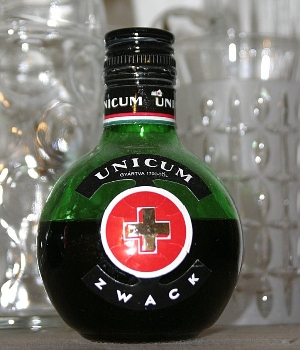
halfdrunk
Half-drunk Zwack: a philosophical impossibility (thanks, Wikimedia)

Zwack—or Unicum, as it’s called in its native Hungary; you can see why they changed the name, I guess—is about the nastiest liquor I’ve ever had the pleasure of drinking. And that includes the rot-gut framboise and the Sombrero Negro tequila my college roommate inherited from her father, from his college days. It is black as tar and viciously strong, and tastes like all the things that prompt your mother to say, “Shush—it’s good for you.”

And thanks to Borat, it’s now being marketed with a faux-bad-English booklet that suggests things like mixing it with energy drink (the so-called “Zwack Attack”).

This I learned from Aaron, who’d just been to a Zwack tasting at Astor Wines. He went for that perverse kind of nostalgia, the kind that makes you long for things you once hated.

See, Aaron and I came to know it when we lived in Cairo. The cheapest flights back to the States were on Malev, which meant a plane change in Budapest and a browse in the duty-free there.

While we lived in Cairo, duty-free liquor–and especially bargains in duty-free–became a near obsession. Cairo is not dry, by any means–people drink their damn-fool heads off. But you can’t just pop down to the liquor store and buy a bottle of whiskey–or a trustworthy bottle, one that won’t make you go blind, anyway. Only after reading The Yacoubian Building (worst. translation. ever., by the way) this year did I realize that the depressed Greek guy whose shop was stocked with nothing but Kleenex was actually a moonshine vendor. So back in the days I lived there, you had to make the most of your duty-free allotment.

Helpfully, you were allowed to use your allotment at a designated booze-and-cigarette joint in Cairo, within a month of your arrival–which meant that whenever you had foreign visitors, you immediately dragged them to the shop to buy the four bottles of booze allowed.

The place stocked the major international brands, but there was also a weird bottom shelf of orphan bottles. They all looked like they’d been retrieved from the cargo hold of a freighter that had sunk in the Suez Canal in 1964–their labels, many in Cyrillic were peeleing off, and they were the most ridiculous shapes. (What is it about weird-shaped booze bottles? The crazier they get, the more disgusting the stuff inside, it seems.) But of course these were the cheap bottles, which is how we ended up with some 30-year-old crème-de-mystery-herbs alongside our Unicum.

At Aaron’s, the Unicum sat there on the sideboard like a black hole of hooch. People would drink room-temperature vermouth before they’d crack the lid on that squat little bottle–its red-and-white cross made you think of first aid, for good reason. At the end of the year, we had a massive party, with everyone contributing all the stray bottles they’d collected at duty-free over the years. Every one of the 50 or so bottles on the sideboard was emptied…except for the Unicum.

So. Now you see my trepidation at the arrival of Zwack in the New World. It could well become the next Jagermeister, but, like legwarmers and jumpsuits, that’s a trend I can’t bring myself to follow.

Aaron was a little more open-minded–the tasting at the wine store seemed to have softened him a little. “Turns out you’re supposed to drink it chilled,” was all he said.

The Mangoes Are Here!

mangoesOh boy! Best bit of diplomacy of recent years — actually, probably the only good diplomacy recently: About a year ago, the US made some deal with India to share nuclear technology…AND MANGOES!

Now, finally, everything is in place, and the first shipments are arriving.

I’ve never had an Indian mango–wait, Peter reminds me I did, in Amsterdam, and it was fucking delicious–so this is extremely exciting.

There’s a whole article in the NY Times: “A Luscious Taste and Aroma from India Arrives at Last”.

The Indian mangoes arriving on our shores are of the Alphonso variety, it turns out. I had one of this kind in Mexico a couple of years ago–it was memorably sweet and creamy, but not so memorable that I could be certain of the name when I got back here (I never know when I hear something in another language, even if it is a proper name). Over the years, I’d nearly convinced myself it was an Ataulfo, even those weren’t quite as tasty, but I could at least get them in the store.

The bad news: The Indian mangoes are irradiated (I don’t know how I feel about this, really). And they’re ten times the price of your regular mango. Yipes. That’s what happens when you fly the babies halfway around the world.

I’m still excited. I’ve got five dollars, a sharp knife and a super-absorbent napkin for wiping my chin.

Home Cookin’

Tal just sent me a link to what looks like a very promising new website: The City Cook.

It speaks particularly to people with small kitchens, and anyone who prefers a home-cooked meal to nightly takeout–so far it’s not totally bursting with content, but what’s there is very helpful. (And actually, it’s kind of nice to have a limited quantity of info–easy to absorb, so then you can keep up with it each week.) It won me over with the big picture of artichokes, but there’s a lot more…

On the same theme, Melissa Clark has been writing a really excellent column in the New York Times, every other week or so. Called “A Good Appetite,” it presents a dish and the thinking–often extemporizing–that went into creating it. This week’s is particularly good, because she talks about how she ruined a soup, how she fixed it, and how she made it better the second time. Here it is, though you’ll have to register to read it: “A Soup with a Difference, Born of Adversity and Error”.

The fact that many of the columns are based on her being hungry for a particular something, then going on to figure out how to make it, is one of the more convincing arguments for learning how to cook.